
The Importance of Building a Strong Core
What is the Core?
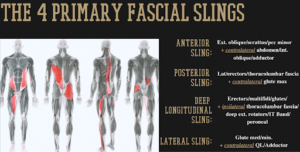
While many people consider the core to be 6-pack abs, the core actually encompasses all structures between the scapula and glutes and is often referred to as the lumbopelvic hip complex. It can be thought of as a cylinder with the diaphragm at the top, pelvic floor and hip girdle at the bottom, abdominal and oblique muscles on the front and sides, and the paraspinal and gluteal muscles as the posterior (back) border. All the muscles work together through fascial slings to allow for efficient movement and force transmission through a combination of stabilization and mobility. The core plays a vital role in athletic performance and injury prevention by providing stability and helping to appropriately transmit forces. Just like the mitochondria is the powerhouse of the cell, the core is the foundation of our body. Increased strength through our core decreases stress on our shoulders, knees, and other joints, ultimately decreasing one’s risk of injury.
Functions of the Core
- Anticipation of Movement
- Spinal Stabilization
- Adequate Support during Weight Bearing Activities
- Link Between Upper and Lower Extremities to Coordinate Movement
Common Core Injuries in Sports
Abdominal strains have been identified as a frequent core injury amongst professional baseball players (5% of all injuries) primarily involving the internal and external obliques with a higher occurrence in hitters with a lead side bias. Furthermore, these individuals are at a significant risk of re-injury (8.15%). When looking at NBA players, hamstring and adductor strains are frequent occurrences during the first month of the season resulting in an average return to play taking 7-10 games or 17-20 days. In the NFL, hip and core injuries are common, especially among defensive backs and wide receivers, causing them to typically miss around 4 games. Hockey players are also prone to core injuries, especially groin and abdominal strains via non-contact mechanisms (90% of injuries). In fact, professional hockey players average 3.2 strains per 1000 player-game exposures, resulting in 11 missed sessions for abdominal injuries and 7 sessions for groin injuries. In addition, hip and groin injuries have also accounted for 14% of all soccer injuries, most often occurring later in the game with 23% being adductor (groin) related with 14 days missed from their sport. Clearly, preventing injuries to the core should be a major focus of athletes in a variety of sports!
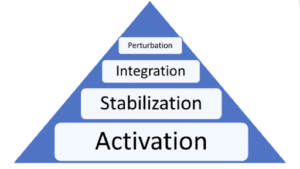
Core Four Pyramid Principle
Core training plays a critical role in optimizing athletic performance and preventing injuries. By following this systematic approach to core training, athletes can improve their core function, stability and athletic performance while decreasing their risk of injury.
- Activation Phase -> reduce pain, restore proper breathing patterns, improve posture/ROM, teach core bracing, increase hip strength, patient education
- Stabilization Phase -> coordinated breath, adequate postural alignment, voluntarily core bracing without cueing, improved hip abduction:adduction ratio, enhanced trunk endurance, proximal stability with distal mobility
- Integration Phase -> restored strength and endurance ratios, no postural breakdown during multi-joint exercises, loading during functional patterns
- Perturbation Phase -> maintain good alignment under loaded conditions, demonstration of good neuromuscular control on unstable surfaces and firm surfaces with eyes closed
Conclusion
Strength, power, and endurance all flow from the core. Building a strong core will help to increase an athlete’s performance as a stronger center will help with controlling the extremities and decreasing other injuries. Optimal hip and core strength allow players to get into their defensive stance and demonstrate improved landing position after jumping. With a strong, stable core as the foundation, athletes improve their ability to perform at their top capacity while reducing their risk of injury. In contrast, the lack of a strong core decreases one’s balance and increases the chance of injury as more stress is transferred to the surrounding structures in order to successfully complete the desired motion.
How Elite Can Help!
Are you or someone in your family dealing with an injury to your core or just looking to improve your core strength and performance? If so, the experienced team of expert Physical Therapists and Sports Performance Coaches at Elite are here to help! To learn more about Physical Therapy at Elite, click HERE! To schedule as Initial Evaluation with one of our PTs, give us a call at 781-436-9843 (Stoughton) or 774-300-3529 (Foxboro) to schedule today!
Interested in improving your sports performance (and core strength!) and elevating your game to a new level this winter? Check out our Winter Sports Performance program! We offer both a 15-week (12/1/25-3/14/26) and 10-week (1/5/26-3/14/26) comprehensive athlete training program at our Foxboro location. Designed for athletes ages 8-22, our personalized, sport-specific training programs will help the athletes in your family make the most of their off-season training program. NOW is the time to start preparing for NEXT season! To learn more or sign up, visit us HERE!
References:
1. Lupowitz LG. Comprehensive Approach to Core Training in Sports Physical Therapy: Optimizing Performance
and Minimizing Injuries. Int J Sports Phys Ther. 2023;18(4): 800-806. doi: 10.26603/001c.84525
2. Myers, William C. Introducing the Core: Demystifying the Body of an Athlete. Taylor & Francis, 2024,
https://books.google.com/books?hl=en&lr=&id=CZ0LEQAAQBAJ&oi=fnd&pg=PT14&dq=what+exactly+is+the+core+
physical+therapy+&ots=Zlq-
RWt9U7&sig=9x7ViWw1TkIGz59GP2PBR1yLBHs#v=onepage&q=what%20exactly%20is%20the%20core%20
physical%20therapy&f=false.
3. Rodríguez-Perea Á, Reyes-Ferrada W, Jerez-Mayorga D, et al. Core training and performance: a systematic
review with meta-analysis. Biology of Sport. 2023;40(4):975-992. doi:10.5114/biolsport.2023.123319.
4. Olivia-Lozaho JM, Muyor JM. Core Muscle Activity During Physical Fitness Exercises: A Systematic Review. Int
J Environ Res Public Health. 2020;17(12):4306. doi: 10.3390/ijerph17124306.
5. Huxel Bliven KC, Anderson BE. Core Stability Training for Injury Prevention. Sports Health. 2013;5(6):514-522.
doi: 10.1177/1941738113481200.