
Mobility Exercises for your Thoracic Spine
Don’t forget about the thoracic spine!
The thoracic spine consists of 12 vertebrae in the middle of the back. It plays a crucial role in supporting posture, breathing, shoulder mobility, and neck mobility.
Restrictions in the thoracic spine can lead to compensations elsewhere, including the cervical spine, lumbar spine, or the shoulder—particularly in overhead athletes. Overhead athletes rely on thoracic spine range of motion for force generation and transfer throughout the kinetic chain. Specifically, a decrease in thoracic extension and rotation may result in up to 3x greater prevalence of shoulder and elbow injury in softball players and other overhead athletes. Full overhead motion relies on both scapular mechanics and thoracic mobility.
The thoracic spine is also unique in that it is key for ribcage expansion, so it’s important that you remember to take some deep breaths performing thoracic mobility exercises! If you are looking for some ways to improve your thoracic mobility, here are some good exercises to try.
Foam Roller Exercises
- Foam Roll Thoracic Extension – There are multiple “correct” ways to do this one as you can arch back over the foam roll at varying segments in your thoracic spine. Remember to keep your cervical spine (neck) neutral and avoid tilting your head back toward the floor.

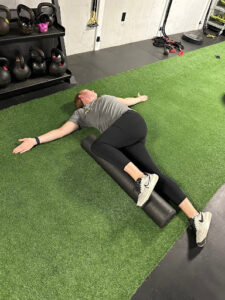
- Foam Roll Open Book – Make sure to keep your knee pinned to the foam roll and to follow your arm with your eyes for a good stretch as you work on rotating through your thoracic spine.
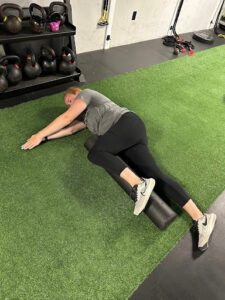
- Foam Roll Thread the Needle – If you are doing this one correctly, you will feel a good stretch in the back of your shoulder as well.
No Foam Roller? No problem!
- Half Kneeling Open Book – With your leg furthest from the wall in front of you, rotate away from the wall while following your hand with your eyes.
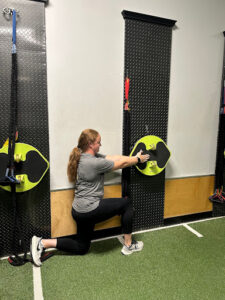
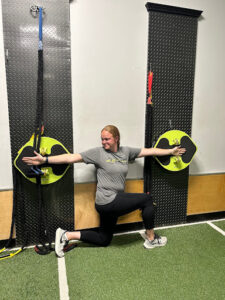
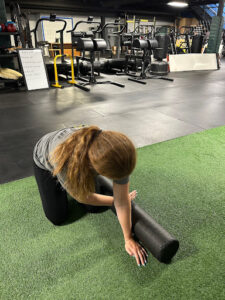
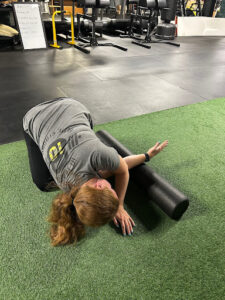
2. Quadruped Thread the Needle to Thoracic Rotation – This is a great combo but can be done separately as well.
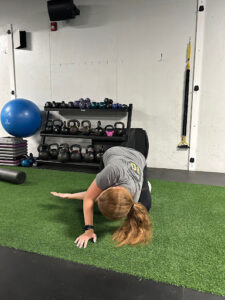
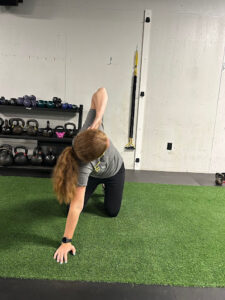
3. Thoracic Extension at the Wall – Think about pushing the wall away as you sink into your upper back.

How Elite Can Help!
Are you or someone in your family dealing with shoulder, neck or upper back issues? If so, the experienced team of expert Physical Therapists and Sports Performance Coaches at Elite are here to help! To learn more about Physical Therapy at Elite, click HERE! To schedule as Initial Evaluation with one of our PTs, give us a call at 781-436-9843 (Stoughton) or 774-300-3529 (Foxboro) to schedule today!
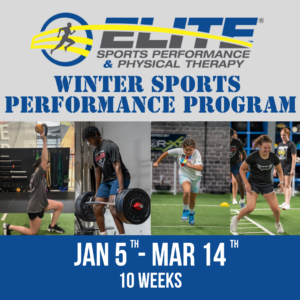
Interested in improving your sports performance and elevating your game to a new level this winter? Check out our Winter Sports Performance program! Our 10-week (1/5/26-3/14/26) comprehensive athlete training program at our Foxboro location kicks off next week and is on sale now! Designed for athletes ages 8-22, our personalized, sport-specific training programs will help the athletes in your family make the most of their off-season training program. NOW is the time to start preparing for NEXT season! To learn more or sign up, visit us HERE!
References
- Kurzec M, Anderson BE. Thoracic Mobility and the Effects it has on the Human Body: An Evidence to Practice Review. Sycamore Scholars. Published 2024. Accessed September 15, 2025. https://scholars.indianastate.edu/clinat/vol7/iss4/19
- Park SJ, Kim SH, Kim SH. Effects of Thoracic Mobilization and Extension Exercise on Thoracic Alignment and Shoulder Function in Patients with Subacromial Impingement Syndrome: A Randomized Controlled Pilot Study. Healthcare (Basel). 2020;8(3):316. Published 2020 Sep 2. doi:10.3390/healthcare8030316
- Johnson KD, Grindstaff TL. Thoracic region self-mobilization: a clinical suggestion. International journal of sports physical therapy. 2012 Apr;7(2):252. Available from:https://www.ncbi.nlm.nih.gov/pmc/articles/PMC3325630/ (last accessed 16.4.2020)
- Morimoto M, Tripathi S, Manoj Kodigudla, et al. Biomechanical effects of thoracic flexibility and stiffness on lumbar spine loading: A finite element analysis study. World neurosurgery. Published online January 1, 2024. doi:https://doi.org/10.1016/j.wneu.2024.01.112